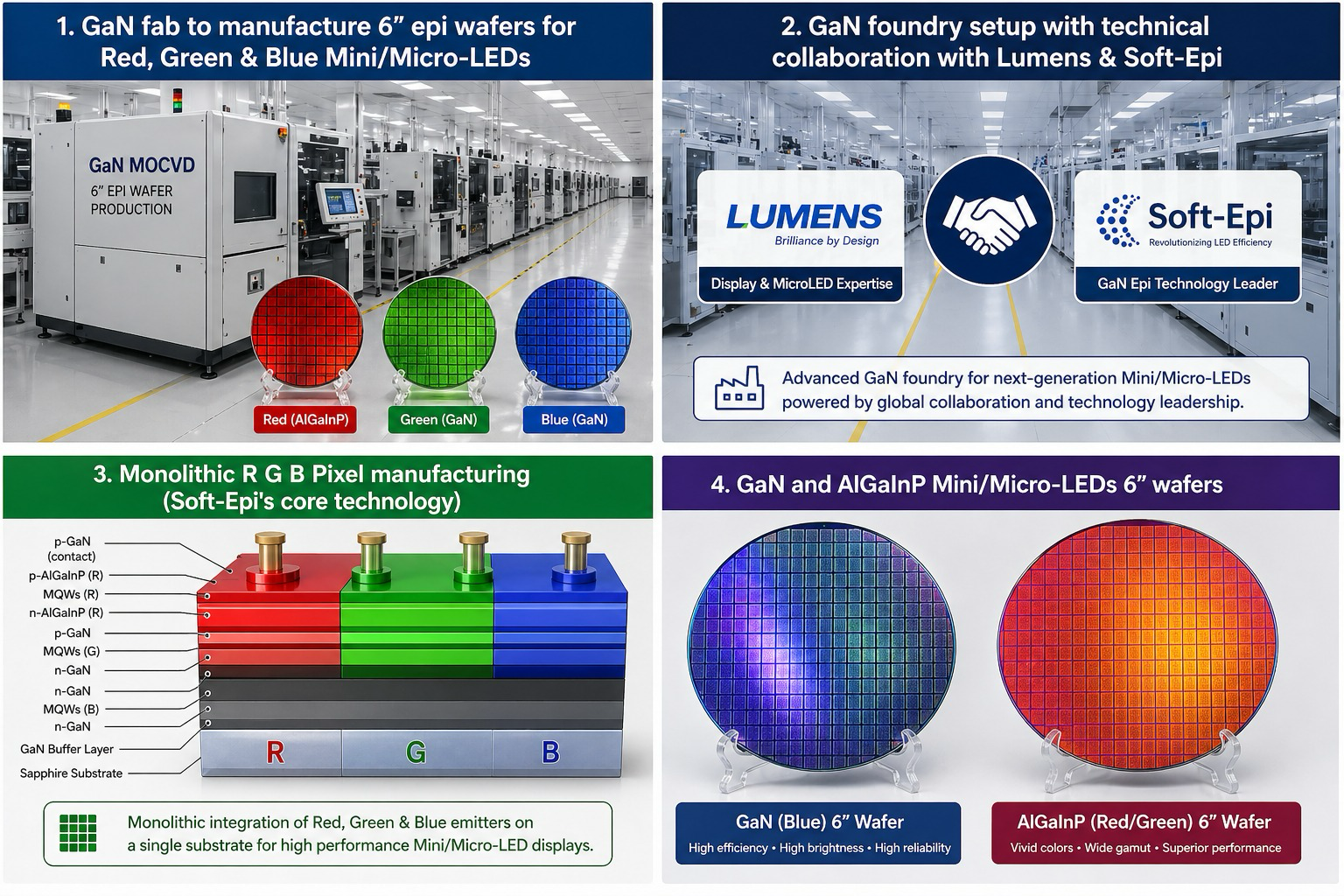
- GaN fab to manufacture 6” epi wafers for Red, Green & Blue Mini/Micro-LEDs
- GaN foundry setup with technical collaboration with Lumens & Soft-Epi
- Monolithic R G B Pixel manufacturing (Soft-Epi's core technology)
- GaN and AlGaInP Mini/Micro-LEDs 6” wafers
Technology
Substrate Preparation
Selection and cleaning of sapphire substrates to ensure low defect density and good lattice compatibility.
GaN epitaxial Growth (MOCVD)
Deposition of GaN layers using MOCVD techniques, forming buffer layers, n-GaN, p-GaN, and multiple quantum wells (MQWs).
Wafer Inspection & Characterization
Measurement of thickness, uniformity, wavelength, and defect density.
Photolithography
Patterning of microLED pixels using high-resolution lithography.
Etching
Dry etching to define individual microLED mesas and expose n-GaN layers.
Wafer Thinning / Substrate Processing
Laser lift-off (for sapphire) or thinning for improved light extraction and integration.
MicroLED Chip Singulation / Mass Transfer Prep
Dicing or preparation for mass transfer processes to place microLEDs onto backplanes.
Testing & Binning
Electrical and optical testing for brightness, wavelength uniformity, and defect sorting.
Integration
Mass transfer of RGB microLEDs onto CMOS/TFT backplanes for display modules.
Flip-chip Mini/Micro-LED Specifications
Absolute maximum ratings and electrical / optical characteristics for Red, Green, and Blue flip-chip LEDs, organized in a clean summary layout for product and technology presentations.
- Flip-chip LED specifications for Red, Green, and Blue emitters
- Measured at Ta = 25 °C and If = 5 mA
- Includes absolute maximum ratings and electrical / optical characteristics
If = 5 mA
Electrical and optical values are shown at the same current condition for easier comparison.
Ta = 25 °C
All maximum ratings and typical values are referenced after packaging at room temperature.
Pulse forward current and viewing angle remain manufacturer inputs and are visually flagged.
Red Flip-chip LED
620–625 nm · 622.5 nm typ.
Absolute Maximum Ratings
Green Flip-chip LED
520–535 nm · 527.5 nm typ.
Absolute Maximum Ratings
Blue Flip-chip LED
465–475 nm · 470 nm typ.
Absolute Maximum Ratings
Red Color Flip-chip LED
620–625 nm · 622.5 nm typ.
| Parameter | Condition | Min. | Typ. | Max. | Unit |
|---|---|---|---|---|---|
| DC Forward Voltage | @ 5 mA | 1.8 | 2.0 | 2.2 | V |
| Reverse Current | @ −25 V | 0 | — | 0.1 | μA |
| Reverse Voltage | @ −10 μA | 30 | — | 60 | V |
| Dominant Wavelength | @ 5 mA | 620 | 622.5 | 625 | nm |
| Luminous Intensity | @ 5 mA | 175 | 280 | 370 | mcd |
| ESD | HBM | 1 | — | — | kV |
Green Color Flip-chip LED
520–535 nm · 527.5 nm typ.
| Parameter | Condition | Min. | Typ. | Max. | Unit |
|---|---|---|---|---|---|
| DC Forward Voltage | @ 5 mA | 2.2 | 2.45 | 2.7 | V |
| Reverse Current | @ −12 V | 0 | — | 0.1 | μA |
| Reverse Voltage | @ −10 μA | 15 | — | — | V |
| Dominant Wavelength | @ 5 mA | 520 | 527.5 | 535 | nm |
| Optical Power | @ 5 mA | 2 | 4 | 6 | mW |
| Luminous Intensity | @ 5 mA | 34.66 | 69 | 104 | mcd |
| ESD | HBM | 2 | — | — | kV |
Blue Color Flip-chip LED
465–475 nm · 470 nm typ.
| Parameter | Condition | Min. | Typ. | Max. | Unit |
|---|---|---|---|---|---|
| DC Forward Voltage | @ 5 mA | 2.6 | 2.85 | 3.1 | V |
| Reverse Current | @ −12 V | 0 | — | 0.1 | μA |
| Reverse Voltage | @ −10 μA | 15 | — | — | V |
| Dominant Wavelength | @ 5 mA | 465 | 470 | 475 | nm |
| Optical Power | @ 5 mA | 5 | 8 | 11 | mW |
| Luminous Intensity | @ 5 mA | 86.66 | 139 | 190 | mcd |
| ESD | HBM | 2 | — | — | kV |
Applications
Next-Generation Displays
Ultra-high brightness, contrast, and energy-efficient displays for TVs, digital cinemas, home theatres, monitors, smartphones, smartwatches, and tablets.
AR & VR Microdisplays
Microdisplays for AR/VR headsets requiring very high pixel density, low power consumption, and excellent color performance.
Automotive Displays & Lighting
Advanced dashboards, heads-up displays (HUDs), and adaptive lighting systems with high brightness and reliability in harsh conditions.
Large-Scale Digital Signage
Outdoor and indoor video walls, advertising billboards, and stadium displays with high luminance and durability.
Wearables & IoT Devices
Compact, low-power displays for fitness bands, smart glasses, and other connected devices.
Optical Communication (Li-Fi)
High-speed data transmission using visible light, leveraging fast switching capabilities of MicroLEDs.
Biomedical & Sensing
MicroLED arrays for medical imaging, biosensing, optogenetics, and lab-on-chip systems.
Industrial & Defense
Rugged displays and optical systems for avionics, simulation, night vision augmentation, and mission-critical environments.
Micro-Projection & Specialty Lighting
High-resolution micro-projectors and tunable lighting using individually addressable RGB emitters.